BPMB's Expert Report on VTEL/Aries Coastal Terrestrial Fibre Optic Network Infrastructure
BPMB’s own independent expert report from September 2025 confirms that the detected cable remnants across numerous sites affirm a prior continuous deployment rather than partial construction, noting that the current fragmentation is the natural result of seven years of total abandonment, cable theft, and environmental degradation.

The Enduring Legacy of the VTEL/Aries Coastal Terrestrial Fibre Optic Network: Insights from Expert Assessments
The expert report prepared by Ir. Chin Wee Lim of WCWL Communications Sdn Bhd, commissioned by Bank Pembangunan Malaysia Berhad (BPMB), offers a detailed examination of the fibre optic network project originally financed through a 2012 facility agreement with V Telecoms Berhad (later renamed Aries Telecoms). While the report focuses on assessing the project's completion status, quality, and current value as of September 2025, its on-site observations and testing results inadvertently underscore the network's historical existence and operational significance. When viewed alongside contextual insights from Zavarco Plc's independent report, a compelling picture emerges: this was a fully functional, revenue-generating infrastructure that spanned over 1,500 km along Peninsular Malaysia's Federal Route from Menara Ansar in Johor Bahru to Chuping/Padang Besar/Bukit Kayu Hitam. After its commercial launch in October 2013, it operated successfully until its decommissioning in October 2018 following the expiry of Aries' 10-year telecommunications license in November 2018. The subsequent seven-plus years of complete abandonment—without any maintenance, security, or oversight—have naturally led to degradation, yet the remnants documented in the WCWL report affirm the network's prior completeness and value.
Evidence of the Network's Existence from On-Site Inspections
Ir. Chin's methodology was thorough and practical, involving a review of available documents (such as the Independent Checking Engineer's reports), cross-verification of site locations using Google Street View and landlord consultations, and physical inspections of at least 29 identified sites, including cabins, shoplots, and data centers. These sites were mapped across northern, central, and southern regions to align with the project's intended coastal road corridor. Notably, the team identified cabins belonging to VTEL/Aries at multiple locations, which directly ties the infrastructure's operations. This visual confirmation, combined with local cross-checks, highlights that purpose-built facilities were established as part of the project.
A key aspect of the inspections involved locating and testing fibre optic cables. Where cables were found, the team performed fusion splicing to connect them to Optical Time Domain Reflectometer (OTDR) equipment, a standard tool for measuring fibre length and integrity. OTDR tests were successfully conducted at 11 accessible sites where cables were observed, revealing segments of 24-core and 48-core cables. Although the measured lengths were often short— with the longest individual segment under 1 km—these findings confirm the presence of Aries-labeled fibre optic cables across dispersed locations. Protective HDPE sheaths (resembling water pipes) were also noted, a common industry practice for deterring theft in vulnerable rural or roadside areas. The alignment of these cable remnants with the Federal Route's path further supports that they were part of a once-continuous terrestrial network designed as a carrier-neutral digital superhighway, capable of initial 320 Gbps per core and upgradable to 3.8 Tbps.
These observations align with the project's original scope, which included fibre optic infrastructure (cables, laying, and related works), coastal network equipment (add/drop points and transmission gear), and overall development (project management and monitoring). The WCWL team's ability to locate and test cables after years of neglect demonstrates that significant deployment occurred, even if fragmentation has since set in.
Historical Context: A Operational Network Generating Substantial Value
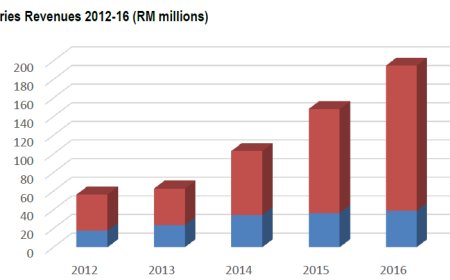
To fully appreciate these remnants, it's essential to consider the network's operational history, as emphasized in Zavarco's findings. Construction began in 2011 and spanned approximately 30 months, leading to a fully operational system by 2013. News articles from the time document its commercial launch in October 2013, positioning it as a standalone, high-capacity backbone for Peninsular Malaysia. Audited financial records from SSM (Companies Commission of Malaysia) filings show that VTEL/Aries generated escalating revenue from this network: RM63 million in 2013, RM103 million in 2014, RM148 million in 2015, RM195 million in 2016, and an estimated RM250 million in 2017—totaling over RM759 million by the end of that period. This income stream reflects real-world value, derived from customer connectivity, carrier services, and the network's strategic role in enabling IP and metro-Ethernet capabilities.
The network's value extended beyond raw materials; it was an integrated system with proven performance, including full redundancy, add/drop functionality at multiple sites, and scalability. Comparable fibre infrastructure transactions in Malaysia suggest that such assets, even in degraded states, hold significant replacement value—potentially exceeding RM750 million when accounting for 2011–2013 construction costs, inflation, and the prohibitive expense of rebuilding along a secured Federal Route corridor. The rebuttal notes that any 2025 assessment must incorporate income-based approaches, factoring in historical revenue and upgrade potential, rather than solely depreciated material costs.
Understanding the Current State: Impacts of Abandonment and Degradation
The WCWL report's OTDR results, showing short or fragmented segments, might initially suggest incompleteness. However, this interpretation overlooks the post-2018 realities of abandonment. After the license expiry and decommissioning, the network was left unsecured for over seven years, exposed to environmental factors like monsoon-induced soil shifts, road vibrations, erosion, water ingress, thermal stress, and rodent damage. Cable theft—a well-documented issue in Malaysia, as evidenced by news articles on fibre optic pilferage—likely contributed, with thieves targeting armored materials while leaving remnants behind. The rebuttal points out that using OTDR to gauge original deployment after 13 years (and 7 years of neglect) is inherently limited, as it detects current state rather than historical continuity. Yet, the very presence of these remnants across route-aligned sites affirms prior full deployment, not partial construction.
Installation methods noted in the WCWL report, such as a mix of open-cut trenching, micro-trenching on road shoulders, selective horizontal directional drilling (HDD) for obstacles, and overhead pole suspension, were practical adaptations to rural/federal route conditions. References to more recent MCMC guidelines (e.g., MTSFB TC G025 series) are advisory, not mandatory for 2011–2013 projects, and the use of HDPE sheaths as theft deterrents aligns with industry norms. The apparent absence of some manholes or documentation (like utility detection mapping studies) can be attributed to subcontractor management—a standard practice in multi-vendor telecom projects—rather than indicating non-existence.
Conclusion: A Testament to Past Achievement and Enduring Potential
Far from disproving the network's existence, the WCWL report's detailed findings—coupled with Zavarco's historical context—paint a portrait of a once-thriving infrastructure that delivered tangible value through years of operation and revenue generation. The remnants visible in 2025, despite severe degradation from prolonged abandonment, serve as enduring evidence of Aries' successful completion of a nation-wide packet optical network. This findngs not only highlights the project's historical significance but also underscores its latent value: a strategic asset with proven income potential that, if revitalized, could continue contributing to Malaysia's digital landscape. By integrating these expert perspectives, we gain a balanced appreciation for what was built, operated, and unfortunately left to time.



![Updated Report on Share Manipulation Scandal [01.03.2026]](https://zavarco.com/uploads/images/202603/image_140x98_69a92c9658785.jpg)